
- Home
- About us
- Products
- Monthly Jewelry Design
- 18k Gold Plated Earrings
- 18k Gold Plated Jewelry Sets
- 18k Gold Plated Rings
- 18k Gold Plated Bracelets & Bangle
- 18k Gold Plated Pendant Necklaces
- 18k Gold Plated Pendants
- S925 Silver Earrings
- S925 Silver Necklace
- S925 Silver Ring
- S925 Silver Jewelry Set
- Custom Jewelry
- Mother's Day Jewelry
- Valentine's Day Jewelry
- Christmas Jewelry
- Religious Jewelry
- Faqs
- News
- Certificate
- Contact us
How does poor craftsmanship affect durability?
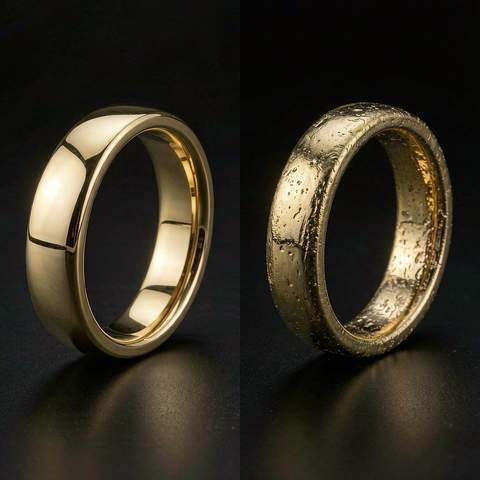
Short answer: a great deal. In gold plated jewelry the gold layer is only a few microns thick, so how long a piece lasts is decided less by the plating itself and more by the craftsmanship behind it — how well the base metal was prepared, how evenly the plating was applied, and how carefully the piece was finished.
Four ways poor craftsmanship shortens a piece's life
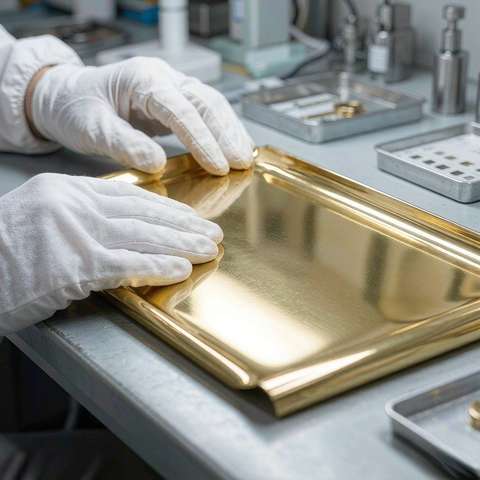
Poor surface preparation
Plating bonds to the metal underneath. If the base is still rough, oily, or carries polishing residue, the gold layer sits on top instead of bonding — and starts peeling or flaking at edges within weeks of daily wear.
Uncontrolled plating
Weak bath control leaves thin and uneven spots. These wear through first, exposing the base metal, which then tarnishes and can leave dark marks on the skin.
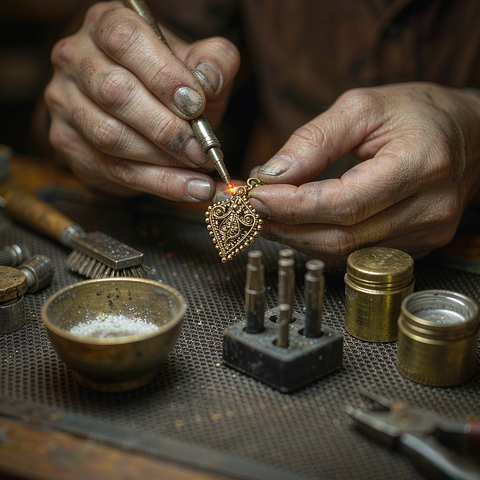
Careless stone setting
Loose prongs and uneven stone seats let stones rattle and eventually drop out — setting quality decides whether a piece stays complete.
Rough finishing
Burrs, sharp edges, and unpolished crevices trap sweat and cosmetics, holding moisture against the metal and speeding up corrosion.
Craftsmanship checkpoints before you commit to a supplier
- Ask how many production steps are controlled in-house, and whether plating happens at the factory or is outsourced.
- Request pieces from a current production run, not only showroom samples.
- Inspect edges, the inside of rings, and the back of pendants — the places where sloppy work hides.
- Confirm compliance reports (REACH, CE) and whether an SGS factory audit is available for review.
- Start with a small pilot order before scaling up.
How we keep craftsmanship consistent at Hengdian (HD) Jewelry
Our own factory in Shanwei Haifeng, Guangdong runs five production lines under one roof, and every piece passes through 14 controlled processes before packing — so preparation, plating, setting, and finishing are managed by one team instead of scattered suppliers. For 18K gold plating over brass we work to our own standard of 0.1–0.3 micron (our factory specification, not an industry-wide figure), and custom plating thickness is available on request. Our jewelry is lead-free, and nickel release stays within REACH limits. The factory is SGS-audited, with REACH, CE, and SGS compliance reports available on request. Holding this consistency across 40,000+ stock designs and 500+ monthly new designs works only because process control comes before output.
Comparing suppliers? Message us on WhatsApp for photos and videos from live production runs, or explore our full catalog. You can also learn about us, contact us, or send an inquiry.
Chat on WhatsAppQuick answers
Does thicker plating always last longer? Not by itself. Adhesion and surface preparation matter just as much — a well-bonded layer outlasts a poorly bonded thicker one.
Can poor craftsmanship be fixed after plating? Usually not economically. Peeling caused by bad preparation requires full stripping and replating, which costs more than doing it right the first time.
How can I check plating quality myself? Rub the piece with a soft cloth for thirty seconds — well-bonded plating should not transfer color — and check high-contact edges.
Can I test your quality with a small order? Yes. Stock designs start at 6–12 pieces per style (product codes beginning with HAI start at 36 pieces), and 5–7 free stock samples are available with freight prepaid.